


Smarter, healthier, better: Key developments in the lighting industrySmarter, healthier, better: Key developments in the lighting industry
The rapid development of artificial intelligence, the internet of things (IoT) and experimental technologies opens up an array of new possibilities.The rapid development of artificial intelligence, the internet of things (IoT) and experimental technologies opens up an array of new possibilities.

The lighting industry is undergoing a transformation in which the efficiency of a lighting fixture is no longer the only focus of development. While LED technology has achieved its full technical and commercial maturity, the spotlight is shifting to advanced integrations, flexibility and solutions centered around people’s health and needs (human-centric lighting). The rapid development of artificial intelligence, the internet of things (IoT) and experimental technologies opens up an array of new possibilities. Understanding these trends and the technological readiness for their application is essential for lighting designers, but also for everyone else participating in the planning of modern work and private spaces.
Human-centric lighting paradigm
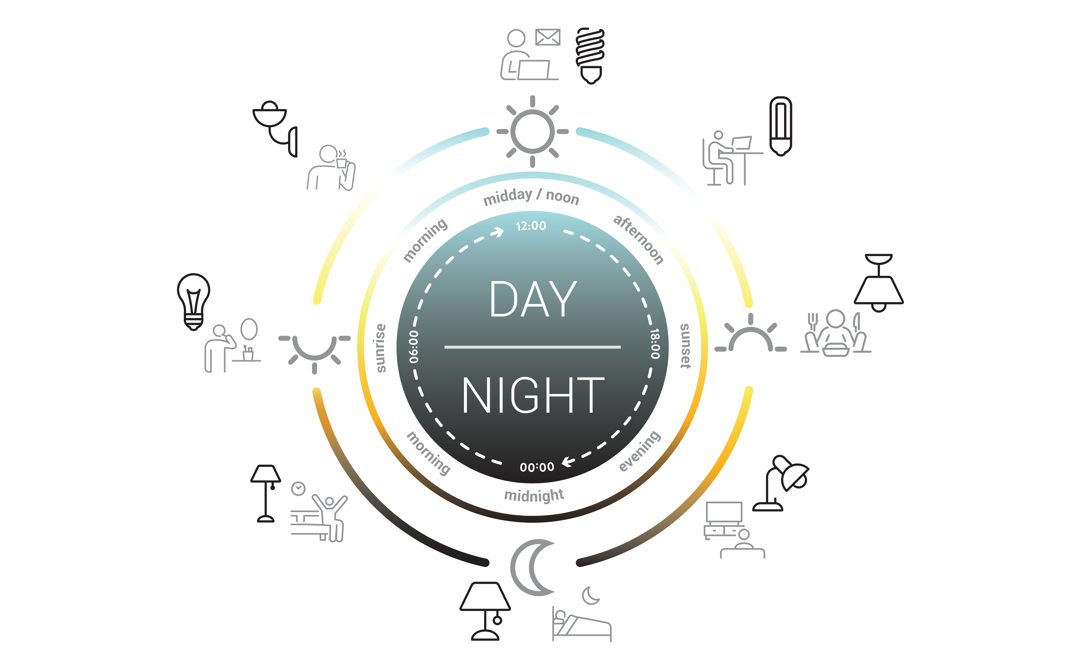
With the growth of awareness and knowledge about the impact of lighting on people’s health, mood and productivity, the understanding of lighting and its role in space is also evolving. The concept of human-centric lighting puts people and their wellbeing first, and values lighting in accordance with its positive effect on people.
“Years before he made Avatar, James Cameron said he would make it when he had the technology he needed for it. It is an interesting parallel with the concept of lighting oriented to people. To bring this ideal to life as best as possible, certain technologies need to develop first. Today, some of the human-centric lighting principles are easier to implement in work and public spaces, because technologies have become more available. Also, some practical experience was accumulated. Demands and needs in this area are being articulated with greater precision and clarity, and they are the subject of growing discussion. Therefore, it is reasonable to expect that the upcoming years will bring a stronger focus on human-centric lighting, now with much better tools for implementation." (Goran Grubiša)
Full maturity of LED, further progress in integrations
Today, LED lighting is the leading standard across households, the industry and public lighting. It started entering commercial markets and homes in the first decade of 2000s, and it was widely adopted between 2010 and 2015. Developed countries were the first to introduce LED via state-level regulation and bans on inefficient incandescent light bulbs and halogen fixtures. Due to a rapidly falling production costs and high energy efficiency, LED soon became the dominant global standard. As technology evolves, the size of the light source is becoming increasingly smaller. With further maturing and adoption, technology becomes more affordable and more available. A massive reduction in energy consumption is also underway–a major trend in many industries, not just lighting.
“LED technology has achieved exceptional efficiency and truly matured. Its further progress will be incremental and measured in millimeters. Moving forward, I expect breakthroughs and major steps to happen in system integration" (Damir Zaninić)
"When it first appeared, field application of LED technology was very demanding in the technical sense. Things would get stuck and take longer than expected. Implementations involved a mix of old and new technologies, with high costs and low cost-effectiveness. With the maturing of LED technology, that has changed completely. It is now easily available and widely used, and it yields excellent results in all kinds of implementations. Today we can clearly see it as a typical technology cycle that has gone through every stage, from the launch and development to wide adoption. These days, new technologies are launched at a faster pace than before, and it is important to stay on top of them. On the other hand, the capacity for the actual installation and optimal use of new technologies do not always develop at the same speed. Therefore, rationality is essential. It is important to understand what the implementation of a new technology means for a process or a space, and what your readiness level is."(Goran Grubiša)
New technologies, new possibilities
The wide availability of large language models (LLM) and the growing number of services built on them are opening up new possibilities for AI to be used in smart homes and home automation. Natural language voice control could go a few steps further than just enabling simple commands to change states of a lighting system. Since light is an electromagnetic wave, it has potential to be used in information transmission. In the upcoming years, a lamp could serve as a medium for information transfer, on top of being a source of light. These kinds of solutions would likely find their use in marketing and advertising. It will be interesting to keep an eye on the ideas and attempts in this area, especially given the growing possibilities for integrating lighting with the internet of things. The coming years could also bring experiments with the use of lasers in signal lighting and safety. Laser beams can penetrate smoke, unlike conventional light beams. On the other hand, laser beams are heavy on the human eye, which has so far obstructed their wider adoption. There have already been attempts to make a breakthrough in this field, and it is worth paying attention to ideas and prototypes that could appear in the near future.