6 things that make a great lighting project6 things that make a great lighting project

In spite of the inevitable change in the industry, the basic principles of a good lighting project have largely remained constant.In spite of the inevitable change in the industry, the basic principles of a good lighting project have largely remained constant.

6 things that make a great lighting project

The last two decades of the European and domestic lighting industry were marked by a series of changes. Several trends in design and materials came and went, and several technological cycles have shaped how we design lighting and how we install it in buildings and environments. At one time, plaster lamps and rattan designs were very popular, while the prevalent tastes of today are very different. We have also witnessed the maturing of LED, and an evolution of how lighting is understood. It is increasingly tied to human wellbeing, aiming to improve health, mood and productivity.

In spite of the inevitable change in the industry, the basic principles of a good lighting project have largely remained constant. The process always starts from a need that the designer must fully understand. Although over the years these needs were served with different technologies and designs, the fundamentals of quality lighting project resist change and serve as a reliable framework for successful work.


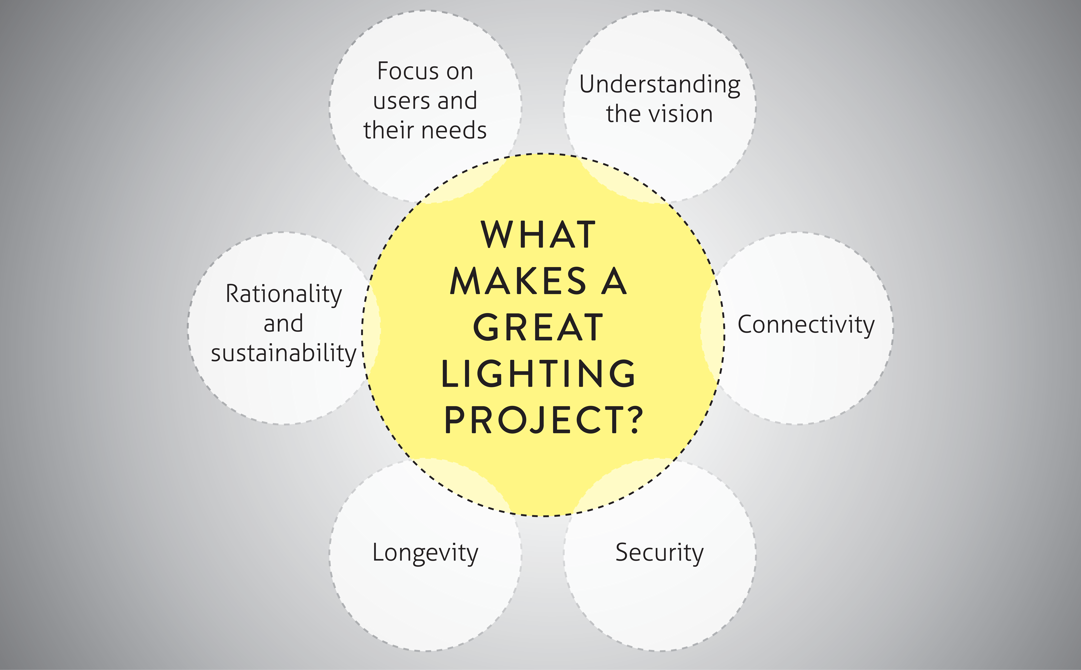
1. Rationality and sustainability: sine qua non of quality design

Regardless of the type and function of the space, or the investment size, good lighting planning takes rationality as one of the most important tasks to fulfil. What does that mean? The rationality of a project is evident in different stages of the work. For instance, it means achieving the same results in a faster, simpler and more efficient way, by using specific know-how and new technologies that have matured and become more available. Also, a rational project fits into budgets and financial plans, while fulfilling users’ needs. Furthermore, rational projects underlie stable and reliable lighting systems which can be maintained over a longer time. They consume less energy, while at the same time enabling maximum security and conforming to technical and regulatory norms.

2. Focus on users and their needs

Whether done 20 years back or today, a lighting project is always developed for a user, and it responds to their specific needs. A successful project emerges in an atmosphere in which the user has enough space and expert support to articulate their ideas and the needs of the space that is being illuminated. Sometimes these needs are not evident, and the lighting designer must-to a greater or lesser extent-articulate them together with the user. Thorough understanding of needs is paramount, and good communication and trust are key to achieving it. Sometimes the needs will change and be agreed upon throughout the project stages. When the user (i.e. customer) is an architectural studio with a vision for a particular space, a good lighting project must fit into that vision and help bring it to life. Sometime the end user will have a business, residential or recreational space with a particular function to fulfil. The better a lighting project addresses the users' needs, the better it is, regardless of the technological cycle in which it is built, or the specific materials and aesthetic shapes dominating the market at any time.

3. Understanding the vision and the space as a whole

Whether it is installed inside or outside, lighting is never a standalone project. It is always a part of a wider architectural or construction plan. A good lighting project takes this fact into consideration from the very beginning and enables synergies from which added value is created. To make that possible, the lighting designer must understand both the goals and the big picture from the start. With business spaces, it is important to understand the business process and specific needs arising from it. In sales-oriented spaces, for example, lighting is planned according to both aesthetic principles and the flow and movement of buyers. Different principles apply in healthcare institutions. Exhibition spaces have their own set of requirements, as well as sports facilities, public areas and other types of spaces.

“A good lighting project must satisfy two sides: professional norms and standards for different types of spaces, and the architectural vision which makes sure that the space is pleasant to use and aesthetically pleasing.” (Stefan Milokanović)

It is important to understand design and the need to make it durable. An awareness of aesthetic forms and materials used in lighting will help lighting designers realize the visual idea developed by the architectural studio. Without exception, a good lighting project will improve the quality and efficiency of a space – and its value.

4. Connectivity: Openness for connecting with other systems

Flexibility and modularity, i.e. openness for connecting with other systems is an important feature of a good lighting project. A lighting syste does not exist on its own, and it doesn’t work in a vacuum. It is always a part of a bigger system, and it needs the ability to connect with other parts and work well with them. Increasingly, those are cameras and alarms, and potentially other things in the future. A good lighting designer pays close attention to how lighting affects other systems, and how other systems affect lighting. It is important to keep in mind that, especially in the last ten years, closed systems have turned out to be less affordable and more difficult to manage in the longer run. Exclusivity and dependence on a single manufacturer or a single technology can result in higher maintenance costs, and it can also limit further development and modernization – a need likely to appear at some point. This is evident in the market year after year. A lighting system is never done to last for a year. If it is well planned, it will adapt to further space development of the space, and it will be easier to modernize when more economical solutions become available in the market. It is important to note that modular systems carry less risk, when compared with the monolithic ones. They are easier to integrate with other systems and they can grow with the space in the future.

5. Longevity: Duration over time

In order for the project to ensure the longevity of a lighting system, it requires the use of standardized solutions that are not complicated to maintain. In other words, the lighting designer makes sure that the components and solutions they apply do not require complicated or expensive maintenance. This approach is based on the use of standard amperage, dimensions and solutions whenever possible. It looks to avoid relying on an exclusive supply chain. Such an approach also requires detailed understanding of the offering of manufacturers, as well as an extensive industry experience. Dimensioning the system for longevity – and setting it, for instance, to avoid overheating – requires knowledge. For example, human eyes will not notice that the lighting operates at 80 percent of its capacity, while that can lead to up to 40 percent in saved energy consumption.

"Delivering a long-lasting lighting system requires breadth and expertise."(Ivan Pamić)

6. Security of the system and its users

Even if it is not always discussed in detail among stakeholders, security is one of the key features in a quality lighting project. Without exception, a reliable lighting designer pays close and detailed attention to the safety of the entire system and those who use it. A good lighting project has safety mechanisms clearly implemented and documented. They reduce the likelihood of damage arising from the system itself and its operation. In quality lighting projects, safety is a given and it will be engineered into the system from the very start, regardless of its type and dimensions. It is one of the fundamentals that lighting designers bring to the table, leaving no room for sloppy work or doubts about the system behaviour and recovery in the case of a storm, a power failure or an emergency.

Loading...